- DotEdge Design

When healthcare organizations think about revenue leakage, they often focus on denied claims, payer disputes, or delayed reimbursements.
But the reality is that revenue loss usually starts much earlier - inside the workflows that support patient intake, eligibility verification, prior authorization, documentation, and coding.
The financial impact is significant:
According to the Medical Group Management Association (MGMA), healthcare organizations can lose between 1% and 5% of net patient revenue due to revenue leakage.
The American Medical Association (AMA) reports that physicians and staff spend an average of 12 hours per week dealing with prior authorization-related activities, creating substantial administrative costs and delays.
The Council for Affordable Quality Healthcare (CAQH) estimates that the healthcare industry could save billions annually by reducing manual administrative processes through better workflow design and automation.
Industry studies consistently show that a large percentage of claim denials are preventable and often stem from issues that occur before a claim is ever submitted.
These aren't just operational problems - they directly affect cash flow, staff productivity, patient experience, and organizational growth.
As a healthcare design studio, we've seen a common pattern: many revenue cycle challenges are actually workflow design challenges. When systems force users to switch between screens, re-enter information, or manually track tasks, errors become inevitable.
Let's explore five common workflow breakdowns where revenue leakage often begins, and how thoughtful product and workflow design can help prevent it.

The revenue cycle starts the moment a patient enters your system.
Yet many healthcare organizations still rely on fragmented intake experiences that require staff to manually enter information across multiple systems.
Impact
Incorrect patient demographics
Outdated insurance information
Eligibility verification failures
Preventable claim denials
Common Example:
Imagine a front-desk coordinator collecting patient information through a paper form and then manually entering it into an EHR.
A single typo in an insurance ID number may not seem significant at the time, but it can eventually lead to claim rejections, delayed payments, and hours of rework.
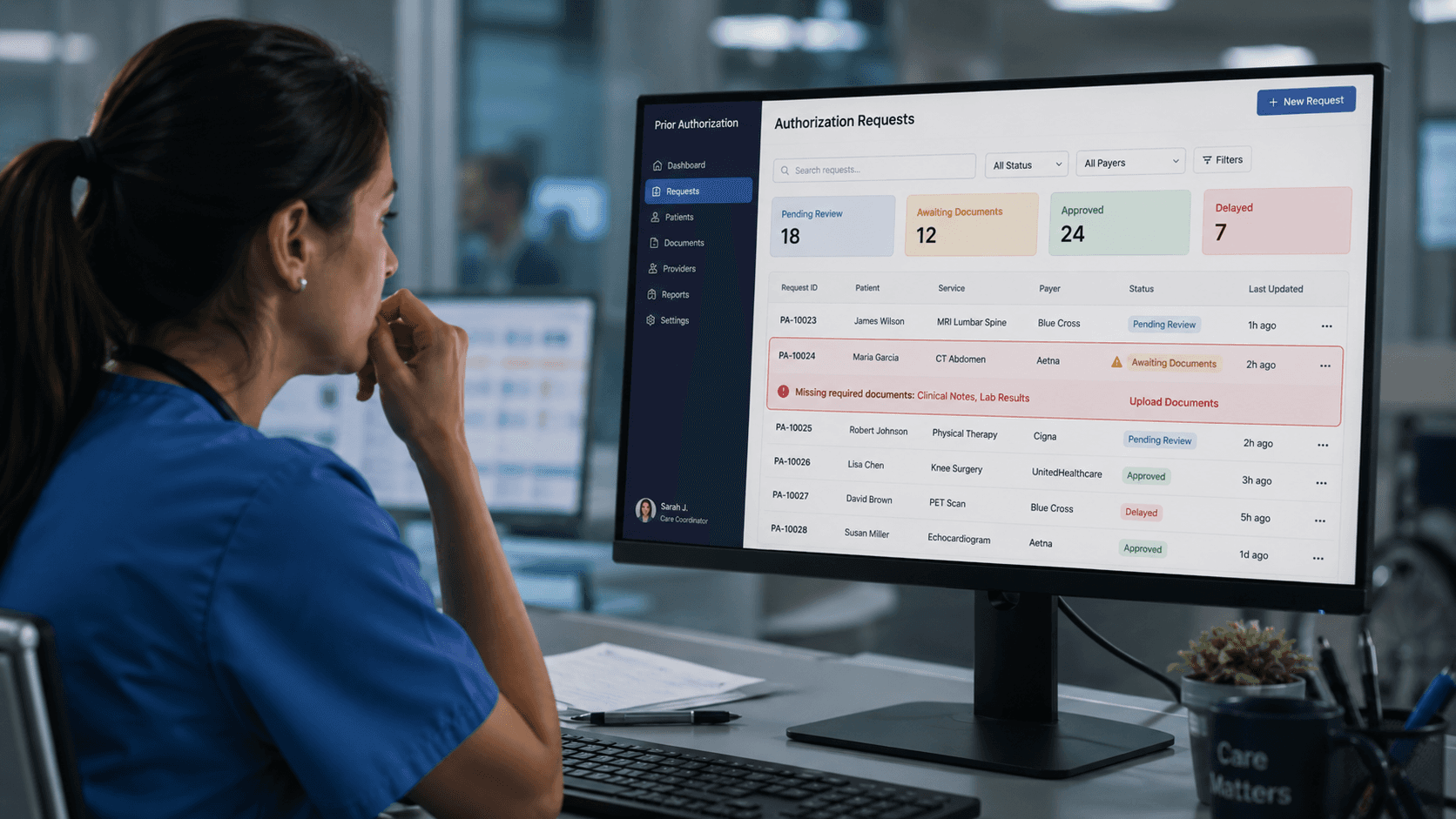
Prior Authorization remains one of the most frustrating administrative processes in healthcare.
The challenge isn't just the authorization itself - it's how information moves between people, systems, and departments.
Impact
Delayed treatments
Slower reimbursement cycles
Increased administrative burden
Lost productivity
Common Example:
A care coordinator submits an authorization request but has no visibility into its status.
Days later, they discover additional documentation was required, causing treatment delays and extending the reimbursement timeline.
The Design Opportunity:
Effective workflow design can:
Provide clear status visibility
Highlight missing requirements early
Create task ownership and accountability
Reduce unnecessary follow-ups
Good design doesn't eliminate Prior Authorization, but it can significantly reduce the friction surrounding it.

Clinical teams document care to support patient outcomes.
Billing teams need documentation that supports reimbursement requirements.
When these two workflows aren't aligned, revenue becomes vulnerable.
Impact
Claim denials
Payment delays
Compliance risks
Increased rework
Common Example:
A clinician completes documentation that accurately reflects patient care, but a required detail needed for coding is missing.
The issue isn't discovered until the claim reaches billing, creating delays and additional administrative work.
The Design Opportunity:
Healthcare products should help users capture the right information at the right time by:
Providing contextual guidance
Highlighting missing documentation requirements
Reducing information silos
Making critical details easier to find
Design can bridge the gap between clinical workflows and reimbursement workflows.

Many organizations invest heavily in denial management teams.
However, resolving denials is only part of the solution.
The bigger opportunity is identifying why denials occur repeatedly.
Impact
Delayed cash flow
Higher operational costs
Increased staff workload
Recurring revenue loss
Common Example:
A billing team repeatedly addresses denials related to missing authorization documentation.
Each denial is resolved individually, but the underlying workflow issue remains unchanged.
The Design Opportunity:
Better workflow visibility helps teams:
Identify recurring denial patterns
Understand root causes
Prioritize high-impact issues
Prevent future denials before they occur
Designing for visibility often creates more value than designing for remediation.

A denied claim doesn't automatically mean lost revenue.
But recovering that revenue depends on how efficiently teams can investigate, correct, and resubmit claims.
Impact
Slower revenue recovery
Increased labor costs
Reduced operational efficiency
Administrative burnout
Common Example:
A revenue cycle specialist must navigate multiple systems to determine why a claim was denied, gather supporting documentation, and coordinate with other departments before resubmission.
What should take minutes often takes hours.
The Design Opportunity
Well-designed workflows can:
Centralize relevant information
Reduce unnecessary system switching
Surface next actions clearly
Accelerate claim recovery
The faster teams can act, the faster revenue returns to the organization.